
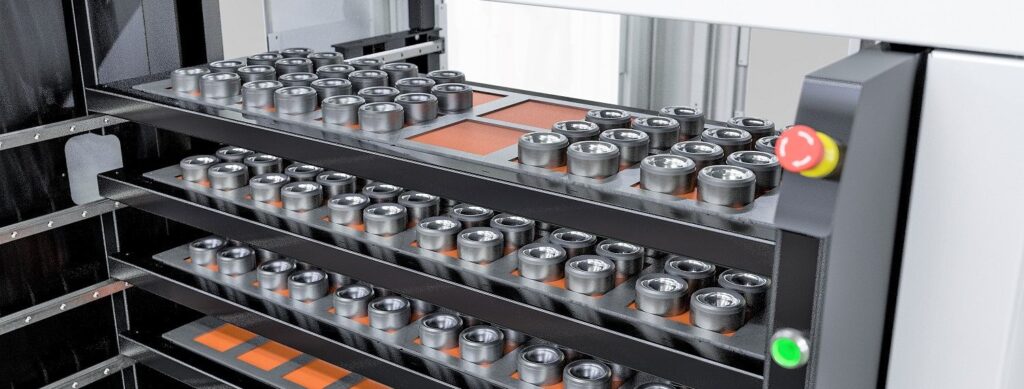
Faster, more accurate, and more cost-efficient machining is only one of the advantages of automating grinding processes. Factors such as higher safety for the operators and their health also play a large role. STUDER is therefore one of the technology leaders in this field. “There are still a lot of prejudices about automation in grinding," says Daniel Schafroth, Systems Division Manager at STUDER. There are frequent concerns that people or jobs could become redundant. “However, for us at STUDER , the opposite holds true: Automation should enable the human operators to do their work more easily, efficiently, and safely," he says. Additionally, the special requirement of grinding necessitates that automation is used very wisely and selectively not every solution used in the industry is suitable for this. But what are the important factors? “For grinding, it is particularly important that processes are performed repeatedly in the same way, with high precision and reliability, for example clamping workpieces and aligning them correctly with micrometer accuracy,” explains Schafroth. Automatic solutions for multi-machine operation are also relevant, as these can greatly relieve the workload of the operators, who then only have to fill magazines and no longer need to laboriously load each machine. However, grinding fundamentally requires the operators to have a high level of competence, and automation should not be something that hinders them,” says Schafroth: “Automation only makes sense where the operator doesn't have to have a decisive influence on the process.”