
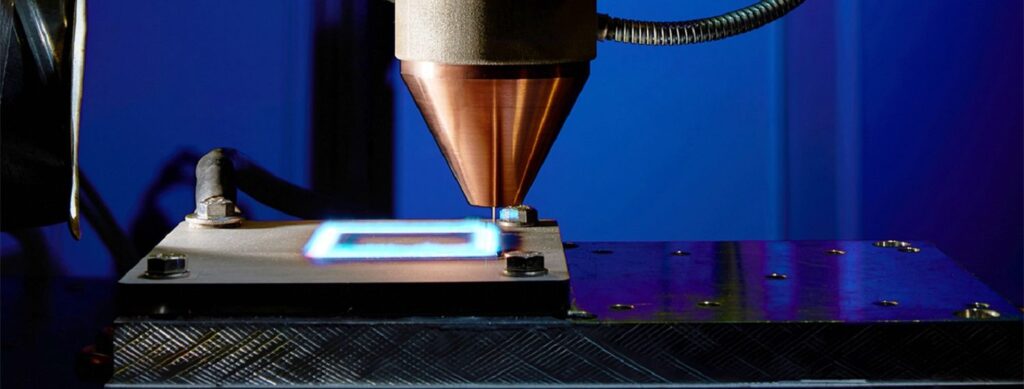
An example of hybrid technology in its purest form has been developed and built by the Fraunhofer ILT for the DVS research project “KoaxHybrid.” In Aachen, the institute engineers have developed a new optical system with glass substrates and an arc torch which unites metal shielding gas (MSG) welding and laser material deposition with an annular beam, thus creating a completely new process. The Collar Hybrid process can be used to increase the welding speed and the deposition rate in metallic 3D printing. The new process combines the best of both worlds: two different additive processes with wire-shaped filler material. We are talking about wire arc additive manufacturing (WAAM) and wire laser material deposition (WLMD). Both processes have system-related advantages and disadvantages: Compared to WAAM, WLMD is costly, has low deposition rates, but is characterized by low heat input and precise layer buildup exactly at the desired location. For this reason, it is particularly in demand in the aerospace industry. If a higher application rate is required, WAAM is the better choice, whereby the achievable surfaces are wavier and the layer buildup is significantly coarser. In joining, the combination of laser beam welding and gas metal arc welding is established under the name LB-GMA hybrid welding. However, this lateral process is direction dependent and only suitable to a limited extent for joining three-dimensional seams. When the processes are combined coaxially, the deposition rate can be increased by up to 150 percent, so that the new direction-independent 3D printing process can also be used for large components. “Because the surface waviness decreases, the amount of post-processing required is significantly reduced compared to the WAAM process,” explains Max Fabian Steiner, a research associate at Fraunhofer ILT .