
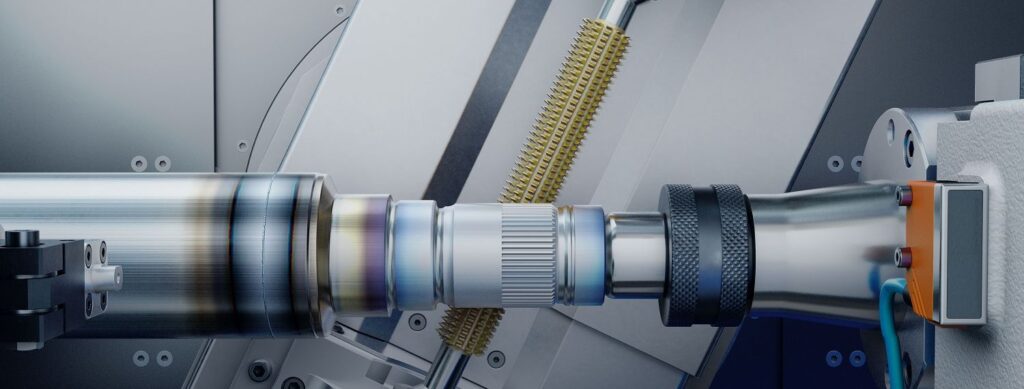
Machining the teeth of a rotor shaft for electric cars has demanding machining requirements. Very few other applications place such high demands as transmission components. The very quiet motor requires the highest surface finishes so that disturbing running noises do not occur. In addition, the number of units in e-mobility is greatly increasing, which is an additional challenge for the mechanical engineering involved. What is needed, therefore, are process-reliable solutions for cost-effective rotor shaft production. EMAG Koepfer HLC 150 H gear hobbing machine demonstrates how this can work, ensuring new productivity in this gear sector. The fact that electric cars don't have any transmissions (apart from the sometimes-indispensable differential) is just a legend – but one that persists quite stubbornly in the public eye. It assumes that the electric motor does not require any gear ratio given its stable torque. In practice, however, it is usually the case that a so-called 1-speed gearbox is used, which helps reduce the speed of the electric motor by a certain factor. As a result, there are numerous gearing elements on components such as the drive shaft, rotor shaft or axle drive, and their component quality must be exceptional so that, for example, there are no loud running noises – these would be audible given the quiet electric motor.