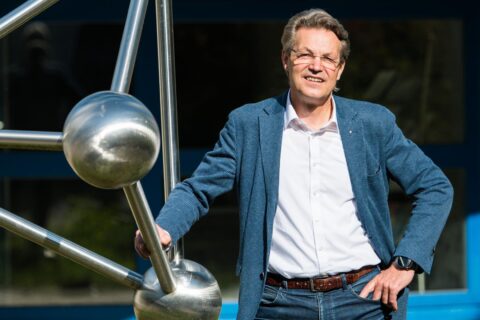

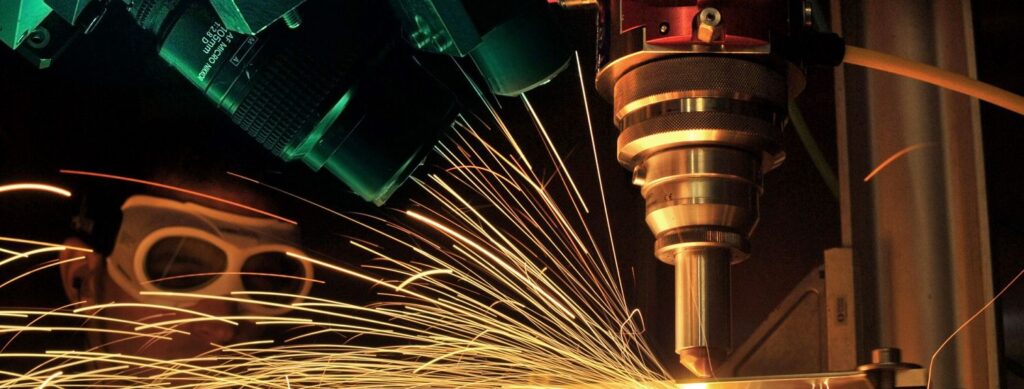
Nowadays small- and medium-sized enterprises (SMEs) can afford lasers, but they often lack the capacity and know-how to optimally fine-tune them, especially when applications change frequently. The BMBF joint project DIPOOL, in which four industrial companies and two research institutes are jointly developing two demonstrators for laser cutting and laser welding, is focusing on laser machines with brains. Technology reporter Nikolaus Fecht learned about the role played by AI and minimally invasive modulation technology from Dr. Dirk Petring of the Fraunhofer Institute for Laser Technology ILT in Aachen. An expert in the laser community once mockingly said, “If you can't afford physicists with PhDs, you can never use a laser efficiently.” On your institute's website, you talk about laser machines with brains. To what extent can they replace the expertise of specialists, Dr. Petring? Dr. Dirk Petring, group leader of Macro Joining and Cutting at Fraunhofer ILT and scientific coordinator of the joint project DIPOOL: “First of all, your quote from an expert is certainly more than 20 years old and has long since ceased to be valid. In the meantime, we are on the path from automated to autonomous laser machines. The focus is entirely on the use of artificial intelligence (AI) because it can increase the autonomy and functionality of machines to an unprecedented degree. AI that has been well-trained by experts detects system deviations, errors and quality defects faster and more reliably than classic monitoring and control systems. AI can analyze sensor signals for more extensive pattern characteristics and even those previously unrecognized by experts.” The joint project is creating a digital process online optimizer for intelligent laser machines, or DIPOOL for short. What is Fraunhofer ILT contributing, who is supporting it? Petring: “We are combing one of the unique characteristics of laser tools – that they can be programmed and controlled temporally and spatially – with machine learning, or ML for short. Specifically, our work is about automatic and robust monitoring, quality assurance and optimization of laser machines for changing manufacturing tasks. DIPOOL aims to demonstrate, for the first time, the advantages of integrating machine learning for the two laser manufacturing processes with the highest turnover worldwide: cutting and welding. Apart from laser manufacturers, all industries that process sheet metal will benefit from the results. We are strongly supported by the Karlsruhe Institute for Industrial Information Technology IIIT, who masters the fundamentals of efficient signal analysis for machine learning. Finally, experts from Marx Automation are implementing the trained ML algorithms in the so-called inference system of the laser control.” Machine learning sinks or swims with the data: What technology is being used to collect it? Petring: “Among other things, a completely new, multispectral sensor system from 4D Photonics. We hope it can be applied to increase the information content of the process signals that can be used with ML, especially in laser beam welding. The smart system technology and sensor technology for laser cutting systems comes from Precitec. Its latest generation of laser cutting heads will be equipped with sensor technology and data interfaces developed specifically for the AI software and the DIPOOL approach.”