
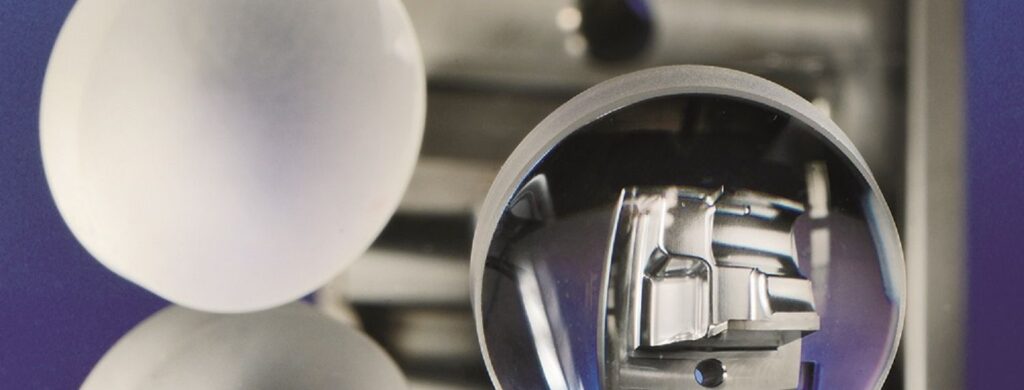
The 5th Conference on Laser Polishing LaP has delivered impressive results regarding laser-based alternatives for polishing components made of glass, metal and plastic. More than 70 experts from all over the world met in October 2022 to discuss the state of the art laser deburring and laser polishing technologies as well as on related topics such as metrology and process control. It's all in the mix: On the first day, LaP number 5 was aimed primarily at companies that manufacture optical surfaces and polish glass as well as plastics. The event kicked off with a presentation from Jena, one of the international centers for glass and optics manufacturing: Anett Jahn, managing director of the company ShapeFab, and Thomas Schmidt, laboratory engineer at the Günter Köhler Institute for Joining Technology and Materials Testing (ifw), encouraged LaP participants to begin using laser polishing. ShapeFab and ifw combine CNC milling and laser-based processes to polish optical surfaces up to 250 mm x 400 mm in size. This hybrid method should soon be able to process any contour and even complex free-form surfaces reliably, quickly and cost-effectively. The company and institute presented a large complex demonstrator component, which was produced in a total of around seven hours, of which about only 10 minutes were spent on laser polishing; the conventional mechanical polishing process would have taken up to ten hours. In the next step, the group now wants to further reduce the CNC machining time. In Jena, process monitoring of the laser with a pyrometer plays an important role. Digital monitoring with this measuring instrument is also used by Manuel Jung from Fraunhofer ILT, who presented the setup of a low-noise closed-loop control for laser polishing of optics at LaP. The scientific member of Willenborg’s team recommended the use of software that allows laser polishing to be carried out reliably with a maximum temperature deviation of less than 0.5 percent. In this way, the Aachen team was able to reduce waviness (MSFE) by as much as a factor of 10. The scientist hopes for further improvements as the institute is developing a thermally even more stable and low-noise control process that no longer uses a pyrometer, but rather a thermocamera and sophisticated statistical methods.